Konnichiwa is the first Japanese word most travelers learn and the one they will use the least like a local. It works, it is polite, nobody will correct you. But real Japan runs on a far more intricate greeting system, one where the time of day, your rank, and how long you have known someone all change the word you say. Hello, it turns out, is never just hello.
The literal meaning gives you the flavor. Konnichiwa breaks down roughly to "as for today," a fragment of an older, longer greeting about the day being fine. It is the 10am to 5pm hello, the business-hours greeting, the one you use with shopkeepers and strangers and the parents of your friends. Say it at 8pm and you will not cause offense, but you will mark yourself, gently, as someone reading from a phrasebook.
Three hellos walk into a day
Japan divides the day into greeting shifts. Before about 10am, it is ohayou gozaimasu, good morning, used with an enthusiasm that suggests the day is a personal friend. From late morning to evening, konnichiwa takes over. After dark, konbanwa, good evening, clocks in. Miss the handoff and nobody minds much, but hit it right and you get the small nod of approval that Japan distributes like Michelin stars: rarely, and only when deserved.
Friends, of course, ignore all of this. Nobody greets a close friend with konnichiwa unless they are being funny or have not seen them in years. Real friends say yo, or ossu, or doumo, which technically means "thanks" but functions as hello, goodbye, excuse me, and general-purpose social glue. Doumo is the dame of greetings: two syllables doing the work of ten.
The greeting is the relationship
This is the part foreigners underestimate. In Japan, the greeting, the aisatsu, is not small talk. It is a tiny ceremony that establishes who everyone is to each other, every single time. Who bows first, who bows lower, who speaks first: all of it is negotiated in about two seconds, silently, dozens of times a day. Get it right and interactions glide. Get it wrong and nothing bad happens, but the glide is gone.
Workplaces take this furthest. Morning greetings at the office are practically roll call, with everyone announcing their arrival to the room. Shops elevate it to theater: staff calling out irasshaimase, welcome, in chorus when you enter, a wall of sound that no customer is expected to answer. The greeting is happening at you, not with you, and that is fine. You are the guest. The ceremony is the service.
The bow that says it all
No guide to Japanese hello is complete without the bow, because the words and the bow are one unit. A small nod with konnichiwa for equals. A deeper bow for thanks or apology. The fabled 45-degree bow is real but rare, reserved for serious gratitude or serious regret, and doing it by accident over a restaurant bill will confuse everyone within ten meters.
Visitors worry about bowing wrong. Do not. The Japanese are delighted you are trying and have extremely low expectations, which is the ideal combination. A sincere nod beats a calculated angle every time. The effort is the greeting.
And here is the secret the phrasebooks skip: the Japanese themselves are constantly adjusting, code-switching between polite and casual mid-sentence, reading the room in real time. Fluency is not knowing the words. It is knowing which hello the moment wants.
Say it on a tee
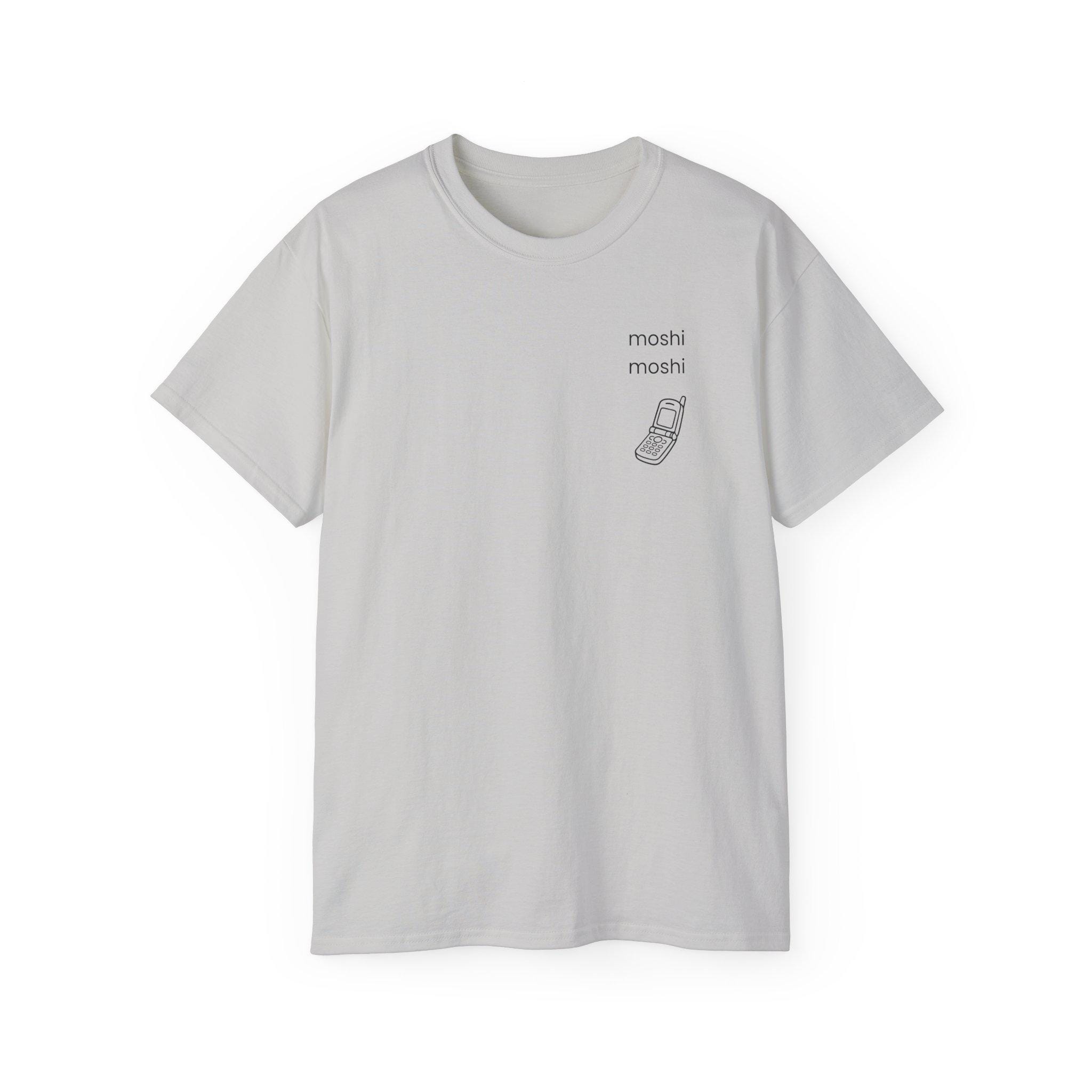
We put konnichiwa on our Konnichiwa Minimal Japanese Greeting Tee because it is the front door of the language: the first word, the polite word, the one that starts every Japan story. Minimal text, maximum meaning. Wear it and you will collect nods from everyone who has ever stood in a Tokyo convenience store at midnight, jet-lagged, trying to remember whether it is konbanwa yet. It is. It is always konbanwa somewhere.
Wear the story
The Konnichiwa Minimal Japanese Greeting Tee, this article, on cotton.
Get it on Etsy